


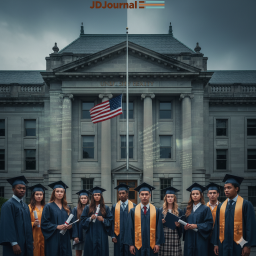

A growing number of U.S. colleges and universities are confronting a pivotal decision that could reshape the relationship between higher education and the federal government. The Trump administration’s proposed “Compact for Academic Excellence” has sparked intense debate across the academic world, forcing institutions to decide whether to align with new federal directives—or risk losing billions of dollars in crucial funding.
At the heart of the dispute lies a fundamental question: how far should federal oversight reach into academic governance? While supporters view the compact as a long-overdue measure to restore accountability and ideological balance on campuses, critics warn it represents a profound threat to academic freedom and institutional independence.
A Push for Ideological Balance—or Political Overreach?
According to administration officials, the Compact for Academic Excellence aims to ensure that federally funded institutions promote “intellectual diversity,” safeguard free expression, and uphold “merit-based hiring practices.” Colleges that voluntarily sign on would reportedly gain priority access to certain research funds, student aid programs, and infrastructure grants.
However, the offer comes with strings attached. Participating universities must agree to regular federal audits and demonstrate measurable progress toward compliance goals. The Department of Education has emphasized that these standards are designed to “protect taxpayers’ investments” and “restore fairness” in academia, which the administration has characterized as increasingly biased and exclusionary.
Faculty groups and higher education associations across the country have echoed those concerns, arguing that the compact undermines the very principles of inquiry and debate it claims to defend.

Mixed Reactions Across the Nation
While some conservative-leaning universities and think tanks have cautiously endorsed the plan, most leading research institutions remain skeptical. MIT has reportedly declined to participate, citing fears that compliance requirements could limit scholarly independence and disrupt its global research partnerships.
In California, Governor Gavin Newsom has taken an even firmer stance, warning that state funding could be withheld from institutions that accept federal terms perceived as politically motivated. “California will not be complicit in federal overreach that seeks to control academic discourse,” Newsom stated.
Meanwhile, several university systems—including those in Texas, Florida, and Georgia—are reviewing the proposal more closely. Some administrators have hinted that financial realities may force their hand, even as faculty members voice resistance. “We’re in a tough position,” admitted one public university president, speaking anonymously. “Rejecting the compact could cost us hundreds of millions in research grants. But accepting it could compromise our integrity as educators.”
Billions of Federal Dollars on the Line
The financial stakes could not be higher. U.S. colleges collectively receive more than $150 billion annually in federal aid, research funding, and grants. These funds support everything from cutting-edge medical studies to financial assistance for low-income students.
A withdrawal or reduction in these resources could devastate many institutions, especially public universities that already face budget pressures from declining state appropriations. Smaller colleges and historically Black institutions (HBCUs) could be particularly vulnerable, as they rely heavily on federal grants to sustain academic programs and community outreach efforts.
Analysts warn that even a partial reduction in funding could lead to layoffs, tuition hikes, and the elimination of key programs. “This is not just a political showdown,” said one higher education policy expert. “It’s a financial reckoning that could alter the landscape of American academia.”
Legal Challenges Loom on the Horizon
As universities weigh their responses, legal experts are preparing for potential court battles. Constitutional scholars argue that the administration’s plan may overstep its authority under the Spending Clause and violate the First Amendment by conditioning funding on adherence to specific ideological positions.
If the compact moves forward, lawsuits are likely to emerge from coalitions of universities and civil liberties organizations seeking injunctions against enforcement. Similar legal confrontations have occurred in past decades over federal education mandates, but few have involved such sweeping implications for academic governance.
“Federal funding has always come with accountability,” noted a Georgetown Law professor. “But using that leverage to shape intellectual content and hiring criteria is something entirely new—and constitutionally questionable.”
The Future of Academic Independence
As decision deadlines approach, university boards, faculty senates, and student groups across the nation are engaging in urgent discussions. Some are forming committees to analyze the potential trade-offs, while others are lobbying state governments for alternative funding sources to maintain independence.
Regardless of which path institutions choose, the broader debate has already reshaped how academia views its relationship with Washington. For many, the controversy underscores the need for clearer boundaries between political influence and educational mission.
“This isn’t just about one administration or one policy,” said a senior administrator at a major Midwestern university. “It’s about whether universities will continue to be places of free thought and innovation—or extensions of political ideology.”
The coming months will reveal whether America’s universities can navigate this moment without sacrificing either their financial stability or their intellectual autonomy. What’s clear is that the outcome will define higher education’s trajectory for years to come.
Stay informed about the latest legal, political, and educational developments shaping the future of academia. Visit LawCrossing.com to explore legal job opportunities in education law, public policy, and higher education compliance. For more breaking legal news and expert analysis, follow JDJournal.com — where the law and higher education meet.
See Related Articles:
•15 Top Law Schools: Best Program for Aspiring Lawyers
•Decode Law Schools Ranking
•Law School Profile


