


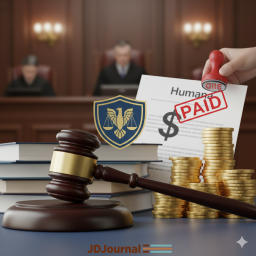

In a significant win for whistleblower attorneys, a federal judge has ordered Humana Inc. to pay more than $32 million in legal fees to the lawyers who represented a former employee in a False Claims Act (FCA) lawsuit that resulted in a $90 million settlement. The ruling underscores the powerful fee-shifting provisions built into the FCA, even as the entire legal framework behind such whistleblower suits faces a potential constitutional shake-up.
The Case That Led to the $90 Million Settlement
The lawsuit was initiated by Steven Scott, a former actuary at Humana, who filed a qui tam action under the FCA back in 2016. Scott alleged that Humana systematically overcharged the federal government for prescription drug plan reimbursements under Medicare Part D, submitting inflated cost data that caused the government to overpay.
Despite the Department of Justice choosing not to intervene, Scott pressed forward with the case. His persistence paid off when Humana agreed to settle for $90 million. Because of the FCA’s relator’s share provision, Scott received 29% of that recovery — roughly $26.1 million — for his role in exposing the alleged fraud.
Judge Awards More Than $32 Million in Legal Fees
After the settlement, Scott’s legal team — led by attorneys from Kellogg Hansen Todd Figel & Frederick PLLC and Phillips & Cohen LLP — requested over $41 million in fees and costs. They argued that their work over several years, in the absence of government participation, warranted premium rates that reflected the case’s national significance.
Chief U.S. District Judge Greg Stivers of the Western District of Kentucky agreed that a substantial award was appropriate but reduced the requested amount, describing some of the proposed hourly rates as “shockingly high” for Kentucky. Nevertheless, the final award of more than $32 million is one of the largest fee awards of its kind in recent memory.

Judge Stivers justified his decision by pointing out that the litigation involved highly complex legal and actuarial issues, significant risk for the relator’s counsel (given the DOJ’s decision not to join the case), and a successful outcome that delivered a major recovery for taxpayers.
Broader Implications for the False Claims Act
This high-profile fee award comes as the very mechanism that made the lawsuit possible — the qui tam provision of the FCA — faces its most serious constitutional challenge in decades.
Earlier this year, U.S. District Judge Kathryn Mizelle in Florida ruled that the FCA’s whistleblower provision is unconstitutional. Mizelle held that allowing private citizens to sue on behalf of the federal government improperly delegates executive enforcement authority to individuals who are not appointed by the President or confirmed by the Senate.
The Justice Department is currently appealing that decision to the 11th U.S. Circuit Court of Appeals, with oral arguments scheduled for December 2025. Legal experts warn that if Mizelle’s ruling is upheld, it could fundamentally change — or even eliminate — the ability of whistleblowers to bring FCA lawsuits without direct government involvement.
Such a shift could dramatically reduce the number of fraud cases brought under the statute, as whistleblower-driven litigation accounts for the majority of FCA recoveries each year.
Why This Ruling Matters
The Humana case is a textbook example of how the FCA’s fee-shifting mechanism incentivizes private enforcement of fraud claims. Without the ability to recover attorneys’ fees, whistleblowers and their counsel might be far less willing to take on lengthy, expensive litigation — especially when the government declines to intervene.
Legal observers are watching closely to see how courts balance fee awards in future cases. Judge Stivers’ decision sends a strong message that courts will continue to reward relators’ counsel for successful recoveries that benefit taxpayers, even when local billing norms would suggest lower rates.
But if the 11th Circuit upholds the Florida decision striking down qui tam suits, similar future recoveries — and their accompanying fee awards — may become rare.
Looking Ahead
For now, the False Claims Act remains intact, and whistleblower suits continue to be a major source of government fraud enforcement. The outcome of the 11th Circuit appeal could set up a Supreme Court showdown in 2026, one that might redefine the contours of whistleblower law for years to come.
Attorneys representing relators, as well as companies that do business with the federal government, are bracing for potential shifts in litigation strategy depending on how the courts rule. If the qui tam mechanism is struck down, enforcement could become much more centralized under the DOJ, potentially reducing the number of fraud cases pursued each year.
Key Takeaways
- Humana Settlement: $90 million settlement over alleged Medicare overbilling.
- Whistleblower Share: Relator received $26.1 million, highlighting FCA’s incentive structure.
- Legal Fees: Judge awarded $32+ million in attorneys’ fees, one of the largest awards of its kind.
- Constitutional Question: FCA whistleblower provision faces major test in the 11th Circuit.
- Future Uncertain: Outcome could reshape whistleblower litigation and government fraud enforcement nationwide.
Explore career opportunities in whistleblower litigation, healthcare law, and government fraud enforcement on LawCrossing. Stay ahead in FCA cases and join firms handling high-stakes legal work Lawcrossing.


