


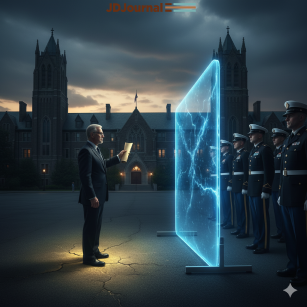
A veteran civilian law professor at the U.S. Military Academy at West Point has filed a lawsuit accusing the institution of violating his free-speech rights. The complaint, submitted on September 22, 2025 in federal court in New York, marks a new front in high-profile disputes over speech, viewpoint, and academic freedoms in U.S. military academies.
Key Allegations
The professor, Tim Bakken, who is the longest-serving law professor at the academy, is seeking to represent others similarly affected via a class action. He alleges that West Point engaged in improper content- and viewpoint-based censorship in breach of the First Amendment.
Specifically, Bakken challenges a policy adopted by West Point called the Academic Engagement Policy, implemented on February 13 of this year. Under this policy, faculty members are required to obtain approval before speaking publicly or publishing in any official capacity.
Incident That Triggered the Suit
Bakken reports that his concerns about the constitutionality of the Academic Engagement Policy were met with hostility. According to the lawsuit, a deputy department head at the academy responded to his objections by turning red, pounding a table, and insisting that Bakken “must obey the regulation.”
In one episode, Bakken requested permission to present a paper at an academic conference later in the year. In response, the law program’s director asked what the title of the paper would be — something Bakken says they had never asked before. Upon follow-up, there was no clarity given about what subject matter might be disallowed under the policy.

Broader Setting: Free Speech at Military Institutions
The lawsuit emerges as scrutiny mounts over free speech practices at U.S. military academies. Under Secretary of Defense Pete Hegseth, these institutions have reportedly been drawing back from some diversity, equity, and inclusion initiatives, restricting language considered “divisive,” and reexamining policies related to race in admissions.
In addition, the Department of Defense has recently introduced tighter restrictions on media covering the military. A new memo requires news outlets to avoid releasing information that has not been sanctioned by the government, or risk losing military press credentials. Media watchdogs fear this could stifle investigative and independent journalism.
Constitutional and Academic Freedom Concerns
Bakken’s lawsuit frames the Academic Engagement Policy as infringing not only on his First Amendment rights but also on academic freedom — the principle that scholars must be able to pursue research and discussion without undue restriction. He asserts that these freedoms are fundamental to a healthy democracy: enabling robust discourse, an informed citizenry, and intellectual growth.
The lawsuit argues that West Point’s requirements for prior approval of speech or publications in “official capacity” are overly vague, creating a chilling effect. Faculty are allegedly unsure what subjects might run afoul of the policy, which may lead them to self-censor rather than risk violating regulations.
Potential Impacts
If successful, Bakken’s lawsuit could have wide-reaching implications:
- It might lead West Point, and possibly other military academies, to revise or rescind policies that require pre-approval of faculty speech.
- It could sharpen legal definitions around what constitutes a viewpoint-based suppression of speech in academic settings, especially those tied to government or military institutions.
- It may influence how military institutions balance operational discipline and order with constitutional protections and openness in academic programs.
Response & Next Steps
As of now, West Point has not publicly responded to the suit. The case’s acceptance as a class action could amplify its reach, bringing in other faculty who feel similarly constrained.
Observers will likely be watching for how the courts rule on the constitutionality of the Academic Engagement Policy, the clarity of what constitutes “official capacity,” and whether the policy’s implementation has been fairly and transparently carried out.
Why This Matters: In recent years, government-affiliated institutions and military bodies have increasingly been under pressure to reconcile institutional discipline with constitutional liberties. Cases like this one test how far regulations can go before they infringe on individual rights—especially in settings where academic inquiry and public speech intersect with national security or military missions.
⚖️ Want to explore careers in law while staying updated on key legal battles? See opportunities and insights related to academic, constitutional, and government law on LawCrossing today.


