


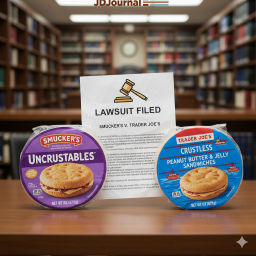

In a new food-industry legal battle, The J.M. Smucker Company, maker of the beloved Uncrustables line, has filed a federal lawsuit against Trader Joe’s, accusing the grocery chain of selling a copycat version of its signature crustless peanut butter and jelly sandwiches. The complaint, filed in the U.S. District Court for the Northern District of Ohio, alleges trademark and trade dress infringement, arguing that Trader Joe’s new “Crustless Peanut Butter and Jelly Sandwiches” unlawfully mimic Smucker’s product design and overall branding.
The Heart of the Dispute
According to the lawsuit, Smucker’s claims that Trader Joe’s product is “confusingly similar” to its Uncrustables sandwiches in both appearance and packaging. The alleged similarities include:
- The Round, Crimped Shape: Both sandwiches are circular and sealed along the edges, with no visible crust—an iconic feature Smucker’s says it pioneered and protected.
- Visual Depictions: Smucker’s points to Trader Joe’s packaging, which includes a bitten sandwich revealing its peanut butter and jelly filling—a detail the company argues mirrors Uncrustables’ trademark design.
- Color and Branding Elements: Smucker’s alleges that Trader Joe’s use of blue packaging tones and similar layout further misleads consumers into associating the Trader Joe’s version with Smucker’s established Uncrustables line.
Smucker’s asserts that these overlapping design cues could cause consumer confusion, leading customers to mistakenly believe the Trader Joe’s sandwiches are made, endorsed, or authorized by Smucker’s.
Smucker’s Defends a Billion-Dollar Brand
Smucker’s has aggressively defended the Uncrustables brand since its debut over two decades ago. What began as a convenient lunchbox innovation has grown into a $1 billion enterprise, producing roughly 1.5 billion Uncrustables sandwiches annually. The company emphasizes that Uncrustables’ unique shape and sealed edges are trademarks that distinguish its product in a crowded marketplace.
The lawsuit underscores how critical this product line is to Smucker’s business. In its complaint, Smucker’s states that Trader Joe’s version is “an unlawful imitation” intended to capitalize on the hard-earned reputation and goodwill associated with Uncrustables.

The company seeks:
- An injunction barring Trader Joe’s from selling the contested sandwiches.
- The destruction of any remaining infringing products or packaging.
- Monetary damages and any profits earned from the allegedly infringing sales.
While Smucker’s did not specify an exact amount in damages, the filing makes clear that it views Trader Joe’s actions as a significant threat to one of its most profitable and recognizable brands.
A Familiar Legal Battle for Trader Joe’s
This is not Trader Joe’s first encounter with a major food manufacturer over product imitation claims. In 2015, Pepperidge Farm sued the grocery chain for selling cookies resembling its famous Milano cookies. That case was dismissed with prejudice in 2016, although details of the settlement were not made public.
Now, Smucker’s joins the ranks of companies challenging Trader Joe’s approach to product design—an approach often praised for its quirky, low-cost versions of name-brand favorites.
Trademark and Trade Dress at the Forefront
At the heart of this case is the question of trade dress protection—a legal concept under U.S. trademark law that protects the visual appearance of a product or its packaging if it signifies the source of the product to consumers.
Smucker’s will need to show that the Uncrustables’ round, sealed shape and packaging have acquired distinctiveness, meaning consumers associate that specific design with Smucker’s. The company will also need to prove that Trader Joe’s design creates a likelihood of confusion among consumers.
Courts typically consider several factors in such cases, including:
- The similarity between the two products’ designs.
- The strength of the plaintiff’s mark.
- Any evidence of actual consumer confusion.
- The defendant’s intent when designing its product.
The outcome could have wider implications for how far trade dress protection extends to simple product shapes—particularly in the food and consumer goods industry, where design overlaps are common.
Representation and Case Details
The case, J.M. Smucker Co. v. Trader Joe’s Co., is being heard in the Northern District of Ohio (Case No. 5:25-cv-02181). Smucker’s is represented by Jones Day, one of the country’s largest and most prominent law firms. As of this writing, Trader Joe’s has not filed a formal response or issued a public statement regarding the claims.
What’s Next?
This lawsuit marks another significant intersection between intellectual property law and consumer product marketing, highlighting the challenges companies face in protecting brand identity in an increasingly competitive retail market. If the court sides with Smucker’s, the ruling could further strengthen the boundaries of trade dress rights for iconic product designs.
Meanwhile, consumers—and legal professionals—will be watching closely as two household names face off in court.
Explore More Legal Career News
For those fascinated by the legal strategies behind cases like this one, there’s no better time to explore the exciting world of intellectual property and trademark law. Whether you’re an attorney looking to pivot into IP litigation or a law student eager to enter the field, LawCrossing offers access to thousands of exclusive legal job listings that aren’t available anywhere else.
👉 Find your next big opportunity in law today. Visit LawCrossing.com to start your search.


