


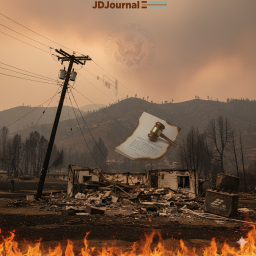

The U.S. Department of Justice has filed a lawsuit against Southern California Edison (SCE) and its parent company, Edison International, alleging that the utility’s equipment caused the 2019 Saddleridge Fire, one of the most destructive wildfires to strike Los Angeles County in recent years.
The complaint, filed in the U.S. District Court for the Central District of California, seeks to recover millions of dollars in costs associated with fire suppression, environmental restoration, and property damage to federal lands. Prosecutors assert that SCE’s negligence in maintaining its power infrastructure and failing to prevent foreseeable hazards directly led to the ignition of the wildfire in the Angeles National Forest.
Details of the Lawsuit
According to the government’s filing, investigators determined that the Saddleridge Fire was sparked when a high-voltage power line came into contact with a steel arm on a transmission tower, creating an electrical arc that ignited surrounding vegetation during strong wind conditions.
The blaze erupted on October 10, 2019, amid powerful Santa Ana winds, and quickly spread from the northern San Fernando Valley into the foothills of the Angeles National Forest. Federal prosecutors allege that SCE had prior knowledge of equipment vulnerabilities and high fire risk during wind events but failed to take adequate safety measures—including de-energizing certain power lines, performing critical maintenance, or installing improved hardware.
The U.S. government claims SCE’s “acts and omissions” amounted to negligence, trespass by fire, and violations of public safety laws, causing significant destruction to federally protected lands. The lawsuit aims to recover the full costs incurred by agencies such as the U.S. Forest Service and the Department of Agriculture in firefighting, cleanup, and ecological rehabilitation.

Impact of the Saddleridge Fire
The Saddleridge Fire scorched 8,799 acres, destroyed or damaged dozens of structures, forced tens of thousands of residents to evacuate, and tragically resulted in one death. The fire’s first point of ignition was located near Saddle Ridge Road in Sylmar—an area known for its rugged terrain and dry vegetation that makes fire suppression especially difficult.
The blaze burned through portions of the Angeles National Forest, a key federal recreation and wildlife area. In addition to the human toll, the wildfire caused severe environmental damage, including soil erosion, destruction of native habitat, and contamination of local watersheds. The Department of Justice contends that the restoration and recovery of these public lands will require extensive long-term investment—costs the federal government now seeks to recover from SCE.
Pattern of Wildfire Litigation
This case adds to a growing list of lawsuits against Southern California Edison, which has faced repeated allegations of wildfire negligence. In August 2025, the federal government filed two similar suits against the utility related to the Eaton Fire (January 2022) and the Fairview Fire (September 2022). Both cases accuse SCE of poor maintenance practices, delayed equipment upgrades, and insufficient vegetation management near power lines.
California utilities, including SCE and Pacific Gas & Electric (PG&E), have been under intense scrutiny for their role in wildfires across the state. These companies have collectively paid billions of dollars in settlements and claims over the past decade. PG&E, for instance, filed for bankruptcy protection in 2019 after facing wildfire-related liabilities exceeding $30 billion.
Federal and state regulators have since pressured utilities to implement stronger safety measures—such as Public Safety Power Shutoffs (PSPS) and infrastructure hardening programs—to prevent equipment from sparking wildfires during extreme weather conditions.
Southern California Edison’s Response
In a statement following the lawsuit, SCE spokesperson Gabriela Ornelas said the company is carefully reviewing the federal complaint and intends to respond through the proper legal channels.
“SCE recognizes the devastating impact of wildfires on California communities and expresses deep sympathy for those affected by the Saddleridge Fire,” Ornelas said. “The company continues to enhance its wildfire mitigation programs, strengthen grid safety, and partner with local and federal agencies to reduce fire risk.”
The utility has previously stated that while its infrastructure may have been involved in certain fires, many of these incidents occurred during extreme, unpredictable wind events. SCE maintains that it has invested billions of dollars in recent years to upgrade its equipment, expand vegetation management, and deploy advanced monitoring systems across its service area.
Legal and Financial Stakes
The lawsuit, formally titled United States of America v. Southern California Edison Co. et al., is listed under case number 25-09547 in the Central District of California. It seeks compensation under federal and state laws governing property damage, negligence, and fire trespass.
If found liable, SCE could face substantial financial penalties on top of existing settlements from prior wildfire cases. The outcome could also influence future policy discussions about utility accountability, wildfire insurance, and infrastructure modernization across the state.
The Department of Justice emphasized that the case underscores the federal government’s commitment to holding utilities accountable when their operations threaten public lands and safety. “When private entities cause destruction to federal resources, they must bear the cost of restoration,” the DOJ said in its filing.
Broader Implications for California’s Utility Industry
The Saddleridge lawsuit represents another critical test of California’s wildfire liability system. Despite new safety protocols and regulatory reforms, utilities continue to face legal exposure for wildfires linked to their electrical infrastructure.
Observers note that such litigation pressures could accelerate efforts to underground power lines, enhance real-time monitoring, and expand microgrid technology—all of which are viewed as essential steps to reducing fire risk in high-wind areas.
As climate change intensifies droughts and wind events across the West, experts warn that the state’s wildfire litigation landscape will likely remain active for years to come.
Legal professionals, especially those specializing in environmental law, energy regulation, and complex litigation, can explore exclusive job openings and opportunities nationwide through LawCrossing. Discover positions that connect legal expertise with meaningful work addressing climate, infrastructure, and corporate responsibility.


