


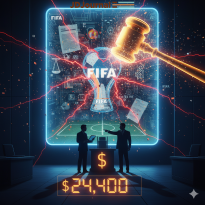

A federal judge in Puerto Rico has issued a sharp warning to the legal community about the perils of unverified AI-generated legal work, ordering two plaintiffs’ lawyers to pay $24,400 in sanctions for submitting briefs containing dozens of inaccurate case citations.
The ruling came from Chief U.S. District Judge Raúl Arias-Marxuach, who presides over a lawsuit brought by the Puerto Rico Soccer League against global soccer body FIFA and the island’s football federation. The plaintiffs allege the organizations conspired to limit sanctioned competitions and stifle opportunities for Puerto Rican players and clubs.
55 Fake or Inaccurate Citations Found
At the heart of the sanctions order were court filings that Judge Arias-Marxuach said contained at least 55 defective citations — some pointing to cases that did not exist, others mischaracterizing precedent. The court noted that such a high number of errors was “strongly suggestive” of reliance on generative artificial intelligence tools such as ChatGPT without subsequent human verification.
Attorneys José Olmo-Rodríguez and Ibrahim Reyes, who represent the Puerto Rico Soccer League, denied using AI to draft their briefs, claiming the errors were “inadvertent” and ultimately harmless to the case’s outcome. They also argued that they corrected the citations once the mistakes were brought to their attention.
But the court was unpersuaded. Judge Arias-Marxuach concluded that the sheer scope of the inaccuracies warranted sanctions, writing that they undermined the court’s ability to trust the integrity of the record and wasted opposing counsel’s time in identifying and rebutting nonexistent authorities.

Sanctions Awarded to FIFA’s Defense Team
The judge ordered Olmo-Rodríguez and Reyes to reimburse FIFA’s legal team for part of the expenses they incurred addressing the defective filings.
Defense lawyers — including teams from powerhouse firms Paul, Weiss, Rifkind, Wharton & Garrison and Sidley Austin — had sought nearly $60,000 in fees. However, the court substantially reduced the requested amount, noting that there was no precedent for such a high monetary penalty for AI-related misconduct.
After adjusting billing rates to reflect Puerto Rico’s market rather than major metropolitan centers like New York or Chicago, the judge awarded:
- $8,425 to Paul Weiss
- $4,435 to Sidley Austin
- Additional amounts to other law firms representing FIFA and related defendants
Judge Arias-Marxuach said the award was “sufficiently substantial” to deter similar conduct but not so punitive as to become excessive or unfair.
A Growing Judicial Crackdown on AI Misuse
This case adds to a growing list of legal decisions addressing the misuse of generative AI in litigation. Since 2023, courts across the country have sanctioned attorneys who have submitted AI-generated documents containing so-called “hallucinated” case citations.
The most widely publicized incident involved New York attorneys in the Mata v. Avianca case, who were fined for citing fictitious cases generated by ChatGPT. Since then, federal and state courts have issued guidelines reminding lawyers that they remain responsible for the accuracy of everything they submit — regardless of whether it was drafted by a human, a paralegal, or an AI model.
Legal ethicists say this latest ruling underscores a broader trend: courts are treating the failure to verify AI outputs as a breach of professional responsibility that can lead to sanctions, fee-shifting, or even disciplinary action.
Lawyers’ Defense: Errors Were “Minor”
Olmo-Rodríguez and Reyes had argued that the citation problems were minor clerical errors that caused no real prejudice to defendants. They also warned that imposing sanctions would create a chilling effect, discouraging lawyers from experimenting with new legal technology tools that could otherwise improve efficiency.
But Judge Arias-Marxuach emphasized that the duty of candor to the court is not optional, and that citing cases that do not exist — regardless of intent — wastes judicial resources and increases litigation costs.
“This court cannot condone conduct that burdens the opposing party with chasing ghost authorities,” the judge wrote, adding that the sanctions were meant to “deter plaintiffs’ counsel, as well as other attorneys practicing in this district, from engaging in similar misbehavior in the future.”
Implications for Legal Practice
For attorneys and law firms nationwide, this ruling is a cautionary tale. AI tools can accelerate legal research and drafting, but their use must be carefully supervised. Experts recommend that firms adopt:
- Verification protocols — requiring attorneys to manually confirm every case citation produced by AI before inclusion in court filings
- Training programs — educating lawyers on AI’s strengths, weaknesses, and risks, especially around hallucinated outputs
- Disclosure policies — informing courts when generative AI is used in the preparation of briefs, a practice some judges have already mandated
The ruling also highlights how clients may ultimately bear the costs of AI misuse — in the form of wasted billable hours or adverse fee awards — unless firms adopt rigorous internal safeguards.
The FIFA Case Continues
The sanctions do not resolve the underlying litigation, which continues under the case name Puerto Rico Soccer League NFP et al. v. Federación Puertorriqueña de Fútbol et al., No. 3:23-cv-01203-RAM. The plaintiffs’ claims of anticompetitive conduct by FIFA and Puerto Rico’s soccer federation will proceed on the merits.
Still, the sanctions order marks a turning point in the case and serves as a reminder that the credibility of attorneys — and by extension, their clients — can be jeopardized by sloppy or unverified filings.
Looking to stay ahead of the curve in an AI-driven legal world?
Explore cutting-edge opportunities in litigation support, compliance, and legal tech roles on LawCrossing. Whether you want to work in AI governance, complex litigation, or risk management, LawCrossing connects you with positions that keep you on the frontlines of the legal industry’s biggest changes.


