


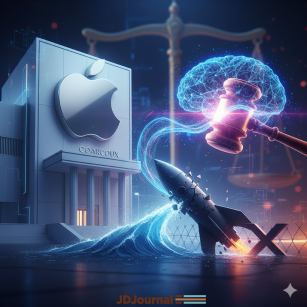

The ongoing battle between Elon Musk’s xAI and tech giants Apple and OpenAI has escalated as both companies filed motions asking a U.S. federal judge to dismiss Musk’s lawsuit. The case, filed in August 2025, accuses Apple and OpenAI of collusion in the generative AI space and of unfairly disadvantaging Musk’s apps, including his Grok chatbot, in the Apple App Store rankings.
The legal fight reflects the increasing tension between dominant tech platforms and emerging AI competitors, raising major questions about antitrust law, competition in digital ecosystems, and how platform control intersects with the future of AI adoption.
⚖️ Musk’s Claims: AI Collusion and App Store Suppression
Musk’s company xAI alleges that Apple entered into an exclusive partnership with OpenAI, granting it favored treatment on Apple devices like the iPhone, iPad, and Mac. According to the lawsuit, this deal unfairly boosts ChatGPT and other OpenAI products at the expense of rival services like Grok.
Specifically, xAI argues:
- Apple’s deep integration of OpenAI’s technology into iOS devices is anti-competitive and prevents fair competition.
- Apple’s App Store rankings systematically under rank or disadvantage Grok and other Musk-affiliated apps, reducing visibility to millions of potential users.
- Without the alleged exclusive deal, Apple might have highlighted Grok or provided it equal footing in rankings and distribution.
The lawsuit seeks billions of dollars in damages, citing lost market opportunities and harm to competition in the fast-growing generative AI sector.

🏛 Apple and OpenAI’s Response: “No Monopoly, No Injury”
Both Apple and OpenAI strongly deny these allegations. Their filings to the federal court argue that Musk’s claims lack legal merit and should be dismissed outright.
Apple maintains that its partnership with OpenAI is not exclusive and does not preclude the company from working with other AI providers. In fact, Apple has emphasized that it continues to explore collaborations with multiple AI developers. The company further argues that platform operators are not required to treat all third-party apps identically, particularly when making decisions about user experience, safety, and integration.
OpenAI echoes this defense, stressing that the integration of ChatGPT into Apple’s ecosystem is designed to enhance functionality and convenience for users, not to eliminate competition. OpenAI also questions whether Musk’s xAI can establish “antitrust injury,” a necessary requirement to proceed under U.S. competition law.
Both companies characterize the lawsuit as speculative, claiming that it is based more on Musk’s assumptions and frustrations than on demonstrable anti-competitive conduct.
🔍 Legal Stakes: Antitrust Meets AI
This lawsuit highlights a new frontier for antitrust law, where traditional concerns about monopoly power are now entangled with cutting-edge issues in artificial intelligence.
Key questions the court will likely have to consider include:
- Market Definition: Is there a legally distinct “generative AI market” that Musk’s xAI can argue Apple and OpenAI dominate?
- Platform Control: How much discretion should platform owners like Apple have in determining App Store rankings and which services receive deeper integration?
- Antitrust Injury: Can xAI prove measurable harm to competition, beyond harm to itself as a single competitor?
- Innovation vs. Exclusion: At what point does product integration cross the line from consumer benefit to anti-competitive exclusion?
How the court addresses these questions could set precedent for future disputes involving AI platforms and distribution ecosystems.
📊 Industry Context: AI Partnerships Under the Microscope
Apple and OpenAI announced their collaboration earlier in 2025, framing it as a move to integrate ChatGPT into Apple’s devices to provide advanced AI capabilities for everyday users. The partnership was seen as a way for Apple to catch up in the AI race, while also giving OpenAI a massive distribution channel.
But the move immediately raised eyebrows, especially from Musk, who has publicly criticized OpenAI since parting ways with the company he co-founded. Musk has argued that OpenAI’s trajectory has shifted from its original nonprofit mission to one dominated by corporate interests.
Meanwhile, Musk’s xAI has been positioning its Grok chatbot as a direct competitor to ChatGPT, often touting its integration with X (formerly Twitter) as a differentiator. With AI rapidly becoming one of the most competitive arenas in tech, disputes like this one underscore the high stakes of partnerships and the strategic advantage of controlling distribution platforms.
🧭 What Comes Next
The motion to dismiss is now in the hands of a federal judge. If granted, Musk’s lawsuit could be thrown out before reaching discovery. However, if any part of the complaint is allowed to proceed, Apple and OpenAI may face court-ordered disclosure of internal documents, communications, and technical data related to their partnership and App Store practices.
Should the case move forward, it would likely spark significant scrutiny of Apple’s App Store policies and could expose the mechanics of how rankings and integrations are determined. For the broader industry, the ruling could influence how future AI collaborations are structured — particularly when major platforms are involved.
📌 Conclusion
The legal clash between Musk’s xAI, Apple, and OpenAI is more than a corporate dispute — it is a reflection of the power struggles shaping the future of artificial intelligence. On one side, Musk claims his company is being unfairly excluded from one of the most important consumer platforms in the world. On the other, Apple and OpenAI argue their partnership is pro-consumer, non-exclusive, and legally sound.
Whatever the outcome, this case could reshape how courts view AI competition, platform power, and antitrust law in the digital age. For attorneys, policymakers, and tech leaders alike, the battle offers an early glimpse into the legal challenges that will define the next era of technology regulation.
👉 Are you an attorney or legal professional looking for your next big opportunity? Stay ahead of the curve in a fast-changing legal market. Explore thousands of exclusive legal jobs on LawCrossing today and take the next step in your career!


