


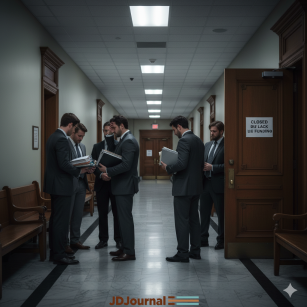

As the government shutdown stretches into its third month, the effects are rippling through the federal justice system, placing unprecedented pressure on court-appointed defense lawyers and threatening to disrupt the constitutional right to counsel.
The judiciary’s emergency funding reserves, which have kept the system operating since the lapse in appropriations, are nearly depleted. Federal public defender offices and private attorneys appointed under the Criminal Justice Act (CJA) are now facing dire financial uncertainty, with many going unpaid for more than three months.
CJA Attorneys Hit Hardest by Funding Freeze
Criminal Justice Act panel attorneys — private lawyers who take on federal criminal defense work when public defender offices have conflicts or capacity limits — are among the hardest hit by the funding lapse. Many have not received compensation since July, and the prolonged shutdown has left them questioning whether they can continue serving indigent defendants without pay.
These panel members play a vital role in maintaining fairness in the justice system, yet without reliable funding, the entire structure of federal criminal defense is at risk. “I don’t know exactly what the inflection point is when folks just say, I can’t do it anymore,” said Jodi Linker, the federal public defender for the Northern District of California.
Ripple Effects Across Federal Defender Offices
The strain is not limited to outside counsel. Public defender offices nationwide are bracing for salary disruptions, with the last guaranteed paychecks expected around October 24. After that, many offices will have no funds to cover payroll or operational costs.

Furloughs — once considered a last resort — are now becoming an increasingly likely scenario. Yet office heads warn that cutting staff would jeopardize their ability to fulfill their constitutional obligations. “It’s a complete and utter disaster,” said A.J. Kramer, the federal defender in Washington, D.C., describing the potential consequences of the budget impasse.
Judiciary’s Budget on the Brink
Historically, the federal judiciary has managed to avoid immediate shutdowns during budget crises by tapping into reserve funds or relying on short-term fixes from Congress. But this time, after years of underfunding and rising costs, those reserves are nearly gone.
Court administrators have warned that if no congressional action is taken soon, courts could be forced to scale back operations, delay proceedings, and furlough thousands of employees — a step not taken in decades.
Some defender offices have vowed to continue operations even under shutdown conditions, citing the ethical and legal necessity of ensuring criminal defendants are represented. However, this would require staff to work without pay, raising serious questions about long-term sustainability.
Constitutional and Ethical Challenges Mount
The most troubling aspect of the funding lapse is its potential to undermine the Sixth Amendment right to counsel. As more attorneys decline new CJA appointments due to nonpayment, defendants could face delays or even find themselves without representation.
In a recent case in Los Angeles, defense attorneys argued that the federal government’s failure to fund CJA panel lawyers constituted a constitutional violation, asking the court to dismiss criminal charges with prejudice. Such arguments underscore the growing legal tension between fiscal policy and constitutional guarantees.
Lisa Wayne, executive director of the National Association of Criminal Defense Lawyers, emphasized the ethical dilemma many attorneys face. “We are being asked to fulfill our professional obligations under conditions that make it nearly impossible to do so effectively,” Wayne said. “This isn’t just a financial crisis — it’s an ethical one.”
Personal and Professional Toll
Approximately 85% of CJA attorneys are solo practitioners or work in small firms, according to judiciary statistics. For many, CJA cases represent their primary or sole source of income. The ongoing shutdown has forced them to deplete personal savings, delay rent and mortgage payments, and cancel family obligations just to stay afloat.
The financial uncertainty has also taken a toll on morale. Staff members in federal defender offices — already earning significantly less than private-sector lawyers — are expressing growing anxiety about their future. Many fear that even if funding is restored soon, the psychological and financial damage will linger.
“I worry what will happen to the system as a whole if we’re not able to guarantee that folks are able to get paid,” said Linker. “We can’t expect people to continue doing this vital work indefinitely without support.”
A System in Peril
Beyond the human and ethical implications, the judiciary’s funding lapse poses a structural risk to the functioning of the entire justice system. Criminal cases could face extended delays, trials might be postponed, and defendants awaiting trial could spend longer periods in pretrial detention — all of which compound existing backlogs and strain local jails.
The Administrative Office of the U.S. Courts has urged Congress to act swiftly to restore funding, warning that each passing week increases the risk of systemic breakdowns. Without resolution, public confidence in the fairness and efficiency of the judiciary could erode further.
A Call for Stability
Legal experts agree that the ongoing crisis underscores a longstanding problem: the judiciary’s dependence on unpredictable funding cycles that leave critical constitutional functions vulnerable to political gridlock.
Restoring full funding for the courts and the Criminal Justice Act program is essential not only to pay attorneys and staff but also to safeguard the rule of law. “Our justice system depends on stability,” said one defender. “When funding becomes a political bargaining chip, justice itself is compromised.”
As the legal community watches this crisis unfold, attorneys, policymakers, and court officials are urging immediate legislative action to stabilize judiciary funding and ensure the uninterrupted operation of federal courts.
For legal professionals seeking stable, well-supported career paths — both in public service and private practice — visit LawCrossing, the largest legal job board featuring thousands of active listings directly from employers across the nation.


