


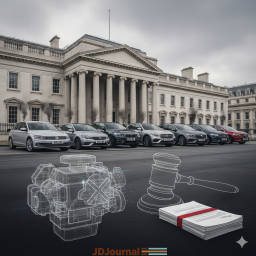

A decade after Volkswagen’s infamous “Dieselgate” scandal rocked the global auto industry, several of the world’s largest car manufacturers are now facing one of the biggest consumer lawsuits in UK history. Over 1.6 million drivers have brought claims against multiple automakers, alleging that their diesel vehicles were fitted with unlawful software designed to cheat emissions tests.
The civil case, which has reached a crucial stage at London’s High Court, accuses companies including Mercedes-Benz, Ford, Nissan, Renault, Peugeot, Citroën, and others under Stellantis of manipulating emissions data between 2012 and 2017. Plaintiffs assert that these automakers misled consumers and regulators by installing “defeat devices” — hidden software that detected when a vehicle was undergoing emissions testing and temporarily reduced nitrogen oxide (NOₓ) emissions to meet legal limits.
When driven under normal road conditions, however, these vehicles allegedly emitted up to 12 times the permitted levels of NOₓ — a pollutant linked to serious respiratory illnesses and environmental harm.
A Decade After Dieselgate: Déjà Vu for the Industry
The lawsuits mark a significant extension of the “Dieselgate” fallout that began with Volkswagen in 2015. That scandal triggered global outrage and led to over €32 billion in fines, recalls, and settlements against the German automaker.
This time, the UK High Court is examining whether similar deceptive practices were used more widely across the industry. The legal proceedings will initially focus on a sample of 20 diesel vehicles, representing models from the accused manufacturers. Judges will determine whether the software used qualifies as a “defeat device” under EU and UK environmental law.

A ruling is expected by mid-2026, and the outcome could have sweeping implications. Should the court find the devices unlawful, it could open the door to additional compensation claims across hundreds of thousands of affected vehicles — with total damages potentially surpassing £6 billion.
Carmakers Push Back
All the automakers involved have denied any wrongdoing and reject comparisons to Volkswagen’s Dieselgate case.
Renault stated that the allegations were “baseless,” emphasizing that its engines complied with all relevant regulations at the time. The company argues that its emissions systems legitimately vary performance based on driving conditions, temperature, and safety requirements — not to deceive testing authorities.
Stellantis, which includes Peugeot and Citroën, has similarly described the claims as “fundamentally flawed,” maintaining that its diesel engines met applicable standards and were never designed to cheat emissions tests.
Ford and Mercedes-Benz have also defended their engineering practices, insisting their vehicles are compliant with environmental laws and that emissions fluctuations are normal due to real-world variability.
The defendants argue that the claimants are attempting to stretch the legal definition of “defeat device” beyond its intended scope — effectively criminalizing legitimate engineering choices.
Claimants’ Perspective: “We Would Rather Cheat Than Comply”
Lawyers representing the drivers take a very different view. They contend that automakers knowingly prioritized compliance shortcuts over legal and environmental responsibility.
According to the plaintiffs, automakers discovered that it was cheaper and faster to modify software to perform differently in test conditions than to invest in cleaner, costlier technology. “They decided it was more convenient to cheat than to comply,” one attorney told the court.
This argument rests on evidence suggesting that emissions systems were calibrated to deliver low NOₓ levels only under laboratory test scenarios — a pattern strikingly similar to the Volkswagen case.
Consumer advocates also highlight the environmental damage and public health risks associated with the alleged deception. “Drivers bought these vehicles believing they were environmentally responsible choices,” said one representative. “Instead, they were polluting far above legal limits.”
A Test Case With Global Implications
The current trial will act as a “test case” for the broader group litigation. Its findings will shape thousands of similar claims already waiting in the wings — including those against BMW, Vauxhall/Opel, and other automakers facing comparable allegations.
If the court rules that defeat devices were used unlawfully, subsequent trials could focus on calculating damages for affected consumers. Compensation could include reimbursement for vehicle depreciation, repair costs, and even moral damages related to environmental harm.
The case also underscores a growing trend in climate-related litigation worldwide, as governments, consumers, and investors hold corporations to stricter environmental standards. The auto industry, in particular, faces increased scrutiny as nations transition toward electric mobility and tighter emissions enforcement.
Industry at a Crossroads
This legal battle represents not only a test of accountability but also a turning point for diesel technology’s legacy in Europe.
Once hailed as a cleaner alternative to gasoline, diesel engines have suffered a dramatic reputational collapse since 2015. Consumer confidence has eroded, cities across Europe have restricted diesel vehicles, and automakers have pivoted aggressively toward hybrid and electric alternatives.
Still, the outcome of this UK trial could reverberate across the continent. If the High Court rules in favor of the plaintiffs, it may trigger additional lawsuits in other European jurisdictions and force manufacturers to reconsider how they approach emissions compliance.
Looking Ahead
As the trial proceeds, all eyes are on the High Court to determine whether these major automakers followed the law or crossed the line. The ruling, expected in 2026, could set a powerful precedent for environmental accountability in the auto sector — and define the limits of corporate responsibility in the post-Dieselgate era.
Whatever the outcome, the case underscores one message clearly: the legal, financial, and reputational costs of emissions deception are higher than ever.
As environmental and consumer litigation reshapes the legal landscape, the demand for skilled attorneys in regulatory compliance, class actions, and environmental law continues to rise. If you’re an attorney or law student seeking to make an impact in emerging fields like sustainability litigation, LawCrossing offers thousands of verified legal job listings from top firms and employers nationwide.
Visit LawCrossing.com today to explore exclusive opportunities in environmental law, corporate compliance, and public interest advocacy — and take the next step toward a career that drives real change.


