


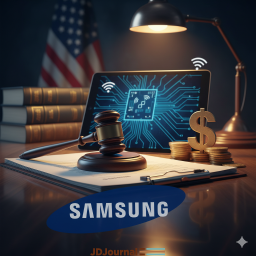

In a significant legal setback for one of the world’s leading technology giants, a Texas federal jury has ordered Samsung Electronics Co. Ltd. to pay $445.5 million in damages to Collision Communications Inc. after finding that Samsung infringed on several patents related to wireless communication technologies. The verdict, issued by a jury in Marshall, Texas, marks another major patent infringement loss for the South Korean electronics company in the United States.
Background of the Case
The lawsuit, originally filed in 2023, centered on four patents held by Collision Communications, a Massachusetts-based company specializing in advanced wireless communication systems. These patents cover core technologies that enable efficient data transmission and network optimization—innovations that are critical to modern 4G, 5G, and Wi-Fi communications.
Collision claimed that Samsung’s popular line of Galaxy smartphones, tablets, laptops, and other connected devices incorporated technologies protected under its patents without authorization or licensing. According to the complaint, these technologies originated from research conducted under BAE Systems, a major defense contractor that previously developed foundational communication technologies. BAE Systems, however, is not a party to the current litigation.
Jury Findings and Damages Award
After deliberating in the U.S. District Court for the Eastern District of Texas, the jury found that Samsung had willfully infringed on all four patents asserted by Collision Communications. The decision not only validated Collision’s intellectual property claims but also awarded a substantial $445.5 million in damages—a figure representing both lost licensing revenue and compensation for unauthorized use.
The Eastern District of Texas, known for its plaintiff-friendly reputation in patent litigation, has long been a key battleground for technology companies engaged in high-stakes intellectual property disputes. The verdict adds to a growing list of costly rulings against Samsung, which has faced multiple patent-related claims over the past decade, including cases involving Apple, Netlist, and other tech rivals.

Legal Arguments and Industry Implications
Throughout the trial, Samsung maintained that it did not infringe on Collision’s patents and argued that the asserted patents were either invalid or unenforceable. The company’s legal team contended that the patented technologies were based on publicly available standards and that Collision’s claims extended beyond the legitimate scope of its intellectual property.
Collision Communications, however, presented evidence showing that Samsung’s devices utilized key techniques described in its patents—specifically, systems for adaptive modulation, error correction, and efficient bandwidth use in mobile networks. The jury’s decision suggests that Collision’s argument was more persuasive, reinforcing the company’s position that its technology was both novel and improperly used.
Legal experts note that the outcome highlights the ongoing tension between patent holders and global tech manufacturers. As wireless technology continues to evolve, disputes over essential communication standards have become increasingly common. The case underscores the complexity of determining ownership and fair licensing in a market where innovation often builds upon existing research.
Reactions and Next Steps
As of publication, representatives for both Samsung and Collision Communications have declined to comment on the verdict. However, Samsung is widely expected to appeal the decision, potentially seeking to overturn or reduce the damages through post-trial motions or appellate review.
If the verdict stands, it could have financial and operational implications for Samsung’s U.S. business, particularly as the company continues to develop and market new devices equipped with cutting-edge wireless technology. The ruling may also encourage other patent owners to pursue litigation against major tech firms that rely on similar communications infrastructure.
For Collision Communications, the verdict represents a major victory that could strengthen its position in future licensing negotiations. The company has built a reputation for developing high-performance wireless solutions and may now see increased interest from manufacturers seeking to avoid similar disputes.
A Broader Trend in Patent Enforcement
This latest ruling adds to the growing wave of multi-million-dollar patent verdicts targeting major tech players in U.S. courts. Over the past decade, companies like Apple, Qualcomm, and Intel have faced similar cases, reflecting the U.S. judiciary’s willingness to uphold intellectual property rights even against powerful multinational corporations.
The Eastern District of Texas, where the case was tried, remains a favored venue for plaintiffs due to its experienced judges, efficient docket management, and history of favorable outcomes for patent owners. Despite periodic reforms aimed at curbing so-called “patent troll” activity, legitimate patent enforcement actions—like that of Collision Communications—continue to find strong support in the jurisdiction.
What This Means for the Tech Industry
The verdict against Samsung serves as a reminder that intellectual property compliance remains critical for any company operating in the hyper-competitive technology sector. As innovation accelerates, so does the risk of inadvertent infringement, particularly in areas like wireless communication, semiconductors, and artificial intelligence.
For corporations, this case highlights the importance of robust patent due diligence and licensing strategies to prevent costly legal battles. For smaller innovators like Collision, the ruling demonstrates that the U.S. legal system can still provide a fair platform for protecting innovation against global giants.
Conclusion
The $445.5 million judgment against Samsung underscores the high stakes of modern patent litigation and the growing value of wireless communication technologies in today’s connected world. As the company prepares its legal response, the outcome will likely be watched closely by industry leaders, patent attorneys, and investors alike. Whether Samsung can overturn the verdict or reach a settlement remains to be seen, but one thing is certain—the battle over wireless innovation is far from over.
💼 Looking for Your Next Legal Opportunity?
If you’re inspired by this landmark case and want to make your mark in intellectual property law, technology litigation, or patent prosecution, explore hundreds of exclusive legal positions at LawCrossing — the leading job board for attorneys and legal professionals.
Stay ahead in your career and find opportunities where innovation meets law.


