


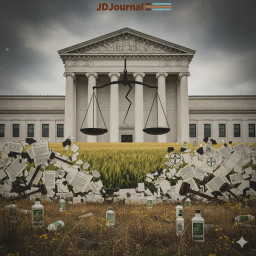

The Missouri Supreme Court has refused to hear Bayer AG’s appeal of a $611 million verdict tied to its Roundup weedkiller, marking yet another major legal setback for the chemical and pharmaceutical giant. The decision leaves intact a lower appellate ruling that upheld the massive damages awarded to three plaintiffs who claimed that glyphosate, the active ingredient in Roundup, caused their non-Hodgkin’s lymphoma.
This move further cements Bayer’s long-running legal troubles over Roundup and underscores the challenges the company faces in trying to limit its mounting liabilities.
The Case Behind the $611 Million Judgment
The case stems from a 2023 trial in Cole County, Missouri, where a jury found Bayer’s Monsanto unit liable for failing to warn consumers about the potential cancer risks associated with glyphosate exposure. The plaintiffs—Daniel Anderson, Jimmy Draeger, and Valorie Gunther—alleged that years of using Roundup led to their diagnoses of non-Hodgkin’s lymphoma.
The jury originally awarded an eye-popping $1.56 billion in damages, including $1.5 billion in punitive damages meant to punish Monsanto for alleged misconduct. However, in April 2024, a trial judge reduced that award to $611 million to comply with constitutional limits on punitive damages established by the U.S. Supreme Court.
Despite the reduction, the verdict remained one of the largest ever upheld against Bayer in its ongoing Roundup litigation.

Bayer’s Appeal Rejected at Every Level
Bayer challenged the verdict, arguing that the trial court improperly admitted certain evidence, including references to prior court opinions critical of the U.S. Environmental Protection Agency’s (EPA) stance on glyphosate safety. The company maintained that federal pesticide law preempts state failure-to-warn claims, asserting that its Roundup label complied with EPA regulations and could not be altered under federal law.
However, in May 2025, the Missouri Court of Appeals, Western District, rejected these arguments, affirming the trial court’s decision in full. The appellate judges found no reversible error in the handling of expert testimony or in the jury’s assessment of Bayer’s liability.
With its state-level options narrowing, Bayer petitioned the Missouri Supreme Court to review the case, but the justices declined to hear the appeal without comment—a move that effectively leaves the $611 million judgment intact.
Bayer’s Mounting Roundup Liabilities
The Missouri Supreme Court’s refusal to hear the case adds to Bayer’s growing legal and financial burdens. Since acquiring Monsanto in 2018 for $63 billion, Bayer has faced tens of thousands of lawsuits alleging that Roundup causes cancer. While the company continues to insist that glyphosate is safe and that its products comply with federal safety standards, juries across the United States have repeatedly found otherwise.
In 2020, Bayer agreed to a $10.9 billion settlement to resolve a significant portion of the Roundup lawsuits but left tens of thousands of claims unresolved. As of 2025, the company still faces approximately 67,000 pending cases, according to court filings.
In anticipation of ongoing litigation, Bayer recently allocated an additional $1.4 billion to cover future claims, acknowledging that its legal exposure remains far from over.
Legal and Regulatory Questions at Stake
At the heart of Bayer’s defense is its argument that federal law preempts state product liability claims. The company contends that the EPA’s repeated findings that glyphosate is “not likely carcinogenic” should shield it from liability under state law. However, courts in Missouri, California, and other jurisdictions have consistently ruled that federal law does not override a manufacturer’s duty to warn consumers under state law.
Bayer has also argued that the trial court’s decision to allow jurors to hear about the Ninth Circuit’s prior criticism of the EPA’s glyphosate findings was prejudicial. Still, the Missouri appellate court ruled that the evidence was properly used to challenge the credibility of the EPA’s position and was relevant to the plaintiffs’ claims.
The broader question—whether federal pesticide labeling laws should preempt state failure-to-warn claims—has been a recurring theme in the Roundup litigation and may eventually reach the U.S. Supreme Court for a definitive ruling.
A Continuing Legal Battle with National Implications
The Missouri Supreme Court’s decision is significant not only for Bayer but also for the future of mass tort litigation in the United States. It reaffirms that juries can hold major corporations accountable for consumer harm even when federal regulators have approved the products in question.
For plaintiffs’ attorneys, the ruling represents a validation of state-level consumer protection laws and signals that punitive damages will remain a powerful deterrent against corporate negligence. For corporate defendants, however, it highlights the challenges of overturning large verdicts once they survive appellate scrutiny.
Given the magnitude of the case and its implications for federal preemption, legal observers expect Bayer to petition the U.S. Supreme Court for review. If accepted, the case could redefine the boundary between federal regulatory authority and state tort law.
Bayer’s Path Forward
While the Missouri verdict stands as one of the largest in Bayer’s Roundup litigation history, the company has managed to win several cases in other jurisdictions, arguing successfully that glyphosate is safe when used as directed. Nevertheless, the repeated losses in high-profile cases continue to tarnish Bayer’s reputation and weigh on investor confidence.
Bayer’s leadership has indicated that it remains committed to defending the product and pursuing appeals where appropriate. However, some analysts have suggested that the company might consider new global settlement strategies or even structural changes—such as separating its crop science division—to insulate its other businesses from ongoing litigation risk.
For legal professionals following the latest in product liability, mass torts, and environmental litigation, staying informed is essential. Explore thousands of cutting-edge opportunities in these legal fields on LawCrossing.Whether you’re pursuing a career in toxic torts, appellate advocacy, or corporate compliance, LawCrossing connects you with the positions that define the next era of legal practice.


