


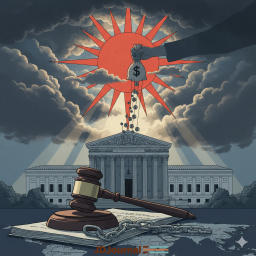

In a landmark decision that could reshape the balance of power between the executive and legislative branches, the U.S. Supreme Court ruled on Thursday that President Donald Trump may withhold $4 billion in foreign aid funds previously appropriated by Congress. The 6-3 ruling marks a significant victory for the administration and raises profound questions about presidential control over federal spending.
The Case at the Center
The dispute arose after advocacy groups filed suit challenging the administration’s attempt to block spending on billions of dollars earmarked for foreign aid, international peacekeeping efforts, and democracy-promotion programs. Critics argued that the administration had overstepped its constitutional role by using what has been described as a “pocket rescission” — an administrative maneuver to freeze or cancel funding without congressional approval.
A lower court had ordered the administration to immediately release the funds, siding with plaintiffs who claimed the withholding violated the Constitution’s Appropriations Clause, which grants Congress exclusive authority over federal spending. But the Supreme Court’s conservative majority overturned that ruling, granting the Justice Department’s request to keep the funds on hold.
The Majority Opinion
Writing for the majority, the justices emphasized the president’s broad authority to direct foreign policy and manage international relations. They argued that requiring the administration to disburse the funds regardless of executive objections could undermine the president’s ability to negotiate with foreign governments and respond to rapidly changing global circumstances.
The decision framed the withholding of funds not as a violation of Congress’s power, but as an exercise of the president’s constitutional responsibility to act in the nation’s foreign policy interests.

The Dissent
Justice Elena Kagan, writing for the court’s three liberal justices, issued a sharp dissent. She argued that the ruling threatens the core constitutional principle of separation of powers, weakening Congress’s control over the federal purse.
“Congress decides how taxpayer dollars are spent,” Kagan wrote. “The executive’s role is to faithfully execute those laws. Today’s decision distorts that balance by granting the president the power to disregard Congress’s explicit directives.”
The dissent also warned that allowing presidents to withhold funding after it has been approved could encourage future administrations to bypass Congress whenever they disagree with spending priorities.
Broader Implications
The ruling is the latest in a series of high-stakes Supreme Court decisions that have sided with President Trump since his return to office. Legal experts say it could set a precedent for significantly expanding executive control over appropriated funds, particularly in the realm of foreign aid and international programs.
For decades, Congress has sought to safeguard its power of the purse as a check on executive authority. By affirming the president’s ability to block already-approved spending, the Court may have shifted that balance, giving future presidents more leeway to shape foreign policy by deciding which appropriated programs receive funding and which do not.
Humanitarian Concerns
The immediate impact of the decision could be significant. With the fiscal year ending on September 30, critics fear that billions in aid dollars will go unused and expire, depriving international partners and vulnerable populations of support. The frozen funds were designated for a range of initiatives, including humanitarian relief, global health programs, and support for fragile democracies.
Advocates argue that withholding this aid will not only harm recipients abroad but also undermine U.S. credibility as a reliable partner on the world stage. “This decision effectively gives the president a green light to weaponize foreign aid for political purposes,” said one advocacy group involved in the lawsuit.
Separation of Powers Debate
The constitutional stakes are equally high. Historically, disputes over presidential impoundment of funds have surfaced during administrations from both parties. In the 1970s, President Richard Nixon attempted to block certain congressional appropriations, sparking legal battles that led to the passage of the Impoundment Control Act of 1974, designed to limit executive overreach in spending decisions.
Thursday’s ruling, however, may weaken those constraints, effectively reviving debates from decades ago about whether presidents can unilaterally decide not to spend money Congress has allocated.
Looking Ahead
While the ruling provides an immediate win for the Trump administration, its long-term implications remain uncertain. Congress could respond by seeking to tighten statutory limits on executive control of appropriated funds, though any legislative solution would likely face political challenges.
Meanwhile, advocacy groups are expected to continue pressing for accountability, warning that unchecked executive discretion over appropriations could erode democratic safeguards. Legal analysts predict that future disputes over presidential spending authority are inevitable, particularly as administrations test the boundaries of this new precedent.
Conclusion
The Supreme Court’s decision to allow President Trump to withhold $4 billion in foreign aid is more than a budgetary dispute — it is a defining moment in the ongoing struggle over the separation of powers. By siding with the executive branch, the Court has strengthened the president’s hand in foreign policy at the expense of congressional control over spending.
As the fiscal year deadline looms, the humanitarian and geopolitical consequences of this ruling will soon become apparent. For now, one thing is clear: the boundaries of presidential authority over federal funds have shifted, setting the stage for a new era of constitutional and political battles.
Be on the Frontlines of Constitutional Law and Government Litigation
The Supreme Court’s ruling on presidential authority over federal spending is just one of many cases reshaping the future of constitutional law, separation of powers, and government accountability. Attorneys with expertise in constitutional litigation, public policy, and administrative law are in high demand as these battles continue to unfold.
Visit LawCrossing today to explore thousands of exclusive legal job listings nationwide. Whether you want to advocate for congressional oversight, defend executive authority, or work in federal appropriations law, LawCrossing can connect you to the firms and organizations at the center of these historic legal debates.


