


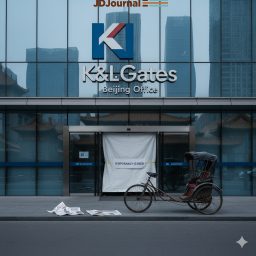

Another major U.S. law firm is scaling back its presence in China. K&L Gates LLP, a Top 50 Biglaw firm, has announced that it will close its Beijing office, consolidating its mainland China operations into its Shanghai hub. The decision marks a significant strategic shift for the firm, which has maintained a presence in Beijing for over two decades.
The move highlights a growing trend among international law firms reassessing their real estate footprints in China in response to economic headwinds, regulatory complexities, and changing client demand.
A Strategic Realignment
K&L Gates’ Beijing office, first opened in 2004, served as an important base for the firm’s corporate, regulatory, and dispute resolution practices. However, according to the firm, maintaining a standalone Beijing office no longer aligned with its broader business objectives.
In a statement, K&L Gates explained that the decision was made after a comprehensive review of global operations aimed at aligning resources with client demand, improving efficiency, and strengthening the firm’s focus on high-performing practices. The Beijing office’s work will now be handled by lawyers based in Shanghai and Hong Kong, where the firm plans to concentrate its China operations.
While K&L Gates emphasized that clients will experience a “seamless transition,” some attorneys and staff in Beijing have been offered relocation opportunities, while others will receive severance packages.

Why Beijing? Why Now?
Beijing has long been a magnet for foreign law firms given its role as China’s political and regulatory hub. However, it is also one of the most expensive cities in the world to operate in, with high office rents and increasing compliance obligations for foreign firms.
Legal industry analysts note that the Chinese market has become more challenging in recent years due to:
- Geopolitical Tensions — Strained U.S.-China relations have complicated cross-border transactions and regulatory approvals.
- Slowed Deal Flow — China’s economy has cooled, leading to fewer high-value transactions that typically drive law firm revenue.
- Regulatory Pressures — Authorities have tightened requirements for foreign firms, making compliance more costly and complex.
- Talent Competition — Recruiting and retaining top legal talent in China has become increasingly expensive, particularly in Beijing.
Given these factors, many firms are choosing to streamline their China operations rather than maintain multiple offices.
A Broader Biglaw Trend
K&L Gates is hardly alone. It is the ninth U.S. law firm in 2025 to shutter or scale back a China office, joining a growing list of firms including Wilson Sonsini, Cleary Gottlieb, Winston & Strawn, and Seyfarth Shaw that have consolidated their operations.
Shanghai appears to be emerging as the preferred base for those firms that remain in mainland China, thanks to its robust financial sector, international business community, and somewhat friendlier business environment for foreign enterprises.
Some firms are even exiting mainland China entirely, opting to serve clients from Hong Kong or other regional hubs such as Singapore, which offer more predictable legal frameworks and fewer compliance hurdles.
Client Impact and Service Continuity
Despite the closure, K&L Gates reassured clients that they will continue to receive full support across corporate, intellectual property, litigation, and regulatory matters in China. Work previously handled by Beijing-based attorneys will be transitioned to Shanghai and Hong Kong teams.
For clients, this consolidation may ultimately result in more centralized service delivery and potentially lower overhead costs. However, for those who rely heavily on regulatory advocacy or government-facing work in Beijing, the lack of a physical presence could present new logistical challenges.
Implications for Legal Professionals
For associates, partners, and staff in Beijing, the closure means making tough career decisions: relocate to another K&L Gates office, seek new employment with another firm, or transition to in-house roles.
The move also signals that global firms are becoming increasingly selective about their physical office locations, favoring a leaner footprint supported by technology and remote collaboration tools. This may mean fewer on-the-ground opportunities for lawyers hoping to build a career in Beijing with international firms.
What This Means for the Legal Industry
The decision underscores a key shift: Biglaw’s China strategy is evolving from expansion to consolidation. Firms are prioritizing profitability and risk management over prestige-driven office networks.
Legal industry experts believe more closures could follow as firms confront:
- Pressure to maintain profitability despite rising costs.
- The need to focus resources on high-demand sectors like private equity, international arbitration, and intellectual property.
- Client preferences for efficiency and competitive pricing, which make smaller, more centralized operations more attractive.
Looking Ahead
K&L Gates’ move could be a bellwether for additional restructuring among international firms operating in China. The consolidation trend is expected to continue into 2026 as firms look for ways to stay competitive while managing risk in a challenging market.
For lawyers seeking opportunities in Asia, this may be a time to focus on Shanghai, Hong Kong, and Singapore, which are poised to remain key regional legal hubs.
🔎 Looking for Legal Career Opportunities in Asia?
As Biglaw firms consolidate operations in China and shift focus to Shanghai, Hong Kong, and Singapore, now is the perfect time to explore your next move.
Visit LawCrossing to find the latest international legal job openings, from associate roles in cross-border M&A to in-house counsel positions across Asia’s leading markets. Stay ahead of the trend and secure your place in the evolving legal landscape.


