



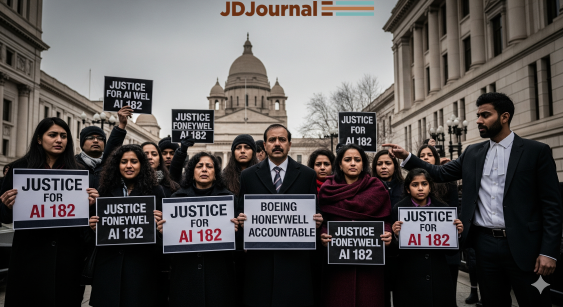
A major lawsuit has been filed in Delaware by the families of four victims killed in the deadly June 12 crash of Air India Flight 171, targeting aerospace giants Boeing and Honeywell. The complaint claims that defective design and unsafe positioning of fuel cutoff switches contributed to the tragedy, which claimed the lives of 260 people when the Boeing 787 Dreamliner went down shortly after takeoff from Ahmedabad, India, en route to London.
The Lawsuit’s Core Allegations
According to the lawsuit, Honeywell manufactured the fuel cutoff switches installed in the throttle control module of the aircraft. The plaintiffs argue that the switches were defectively designed and positioned in a way that made them vulnerable to accidental activation during normal cockpit operations. The lawsuit further contends that Boeing, as the aircraft manufacturer, failed to ensure adequate safeguards to prevent such inadvertent activation.
This legal action comes in the wake of a 2018 advisory from the U.S. Federal Aviation Administration (FAA) that urged — but did not mandate — operators of certain Boeing aircraft, including the 787 Dreamliner, to inspect locking mechanisms on these switches. The FAA expressed concerns about the possibility of accidental fuel shutoff during flight if the switches were inadvertently engaged.
The Indian Aircraft Accident Investigation Bureau’s (AAIB) preliminary report confirmed that Air India did not perform these inspections on the aircraft involved in the crash. Maintenance logs also revealed that the throttle control module had been replaced twice — once in 2019 and again in 2023 — before the fatal flight.
Conflicting Investigative Findings
While the AAIB stated that Air India had complied with all mandatory maintenance requirements and airworthiness directives for the aircraft and its engines, the FAA’s 2018 safety recommendation was not carried out. This gap in compliance is a central piece of the plaintiffs’ case, which suggests that the airline and manufacturers failed to take adequate precautions to prevent a foreseeable disaster.

The lawsuit also references cockpit voice recorder data, alleging that the captain cut off fuel flow to the engines shortly after takeoff, which caused the crash. Plaintiffs argue that the design flaw allowed this to happen unintentionally.
Aviation experts, however, have expressed skepticism about whether the switches could be triggered accidentally, citing their recessed design and protective features. These conflicting opinions set the stage for what could become a complex and closely watched legal battle.
The Human Toll
The lawsuit, titled Paghadal et al v. Boeing Co et al and filed in Delaware Superior Court (Case No. N25C-09-145), seeks damages on behalf of four victims: Kantaben Dhirubhai Paghadal, Naavya Chirag Paghadal, Kuberbhai Patel, and Babiben Patel. The plaintiffs, who live in India and the United Kingdom, are part of a broader group of families seeking accountability.
In addition to the 229 passengers who perished, the crash also killed 12 crew members and 19 people on the ground. Only one passenger survived, underscoring the devastating scale of the disaster. Families say they have been frustrated with the public narrative surrounding the crash, which they believe has focused too narrowly on potential pilot error rather than mechanical or design failures.
Corporate Silence and Legal Strategy
Boeing has declined to comment on the pending litigation, while Honeywell has not yet issued a response. The case is expected to test the extent of liability that manufacturers face in catastrophic air accidents. Legal scholars note that lawsuits against aircraft and component manufacturers can be more favorable to plaintiffs compared to claims against airlines, since manufacturers are not protected by the same liability caps under international aviation treaties.
The choice of Delaware as the venue for the lawsuit is also significant, as many corporations are incorporated in the state and its courts are known for handling complex commercial disputes efficiently.
Broader Implications
This lawsuit could have far-reaching implications for aircraft safety standards and manufacturer liability. If successful, it may push regulators to convert non-binding advisories like the FAA’s 2018 recommendation into mandatory directives, particularly when they involve components critical to flight safety.
It may also reignite scrutiny of Boeing’s safety practices, which have been under intense global attention in recent years following other high-profile crashes and manufacturing concerns. For Honeywell, the case could raise questions about component design and its role in ensuring that cockpit controls are safeguarded against inadvertent activation.
As litigation proceeds, families of the victims say they hope for not only financial compensation but also a clearer picture of what caused one of the deadliest air disasters in India’s recent aviation history.
Looking for a Career in Aviation or Product Liability Law?
This case highlights the growing demand for skilled attorneys in aviation litigation, product liability, and international law. If you want to explore career opportunities in these high-stakes practice areas, visit LawCrossing today. Discover thousands of legal jobs, from top law firms to in-house counsel roles, and take the next step in your legal career.


