


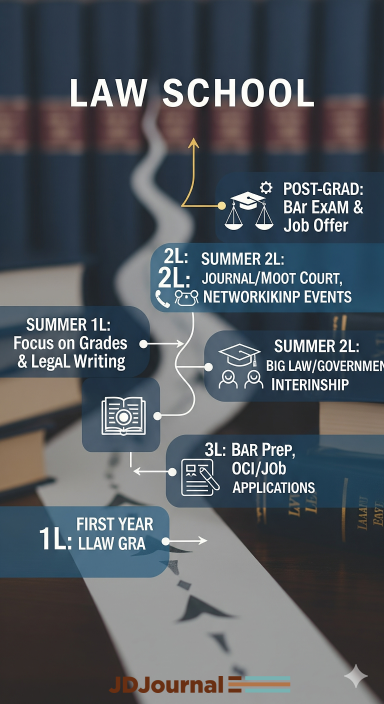

Graduating law school is only part of the journey. Securing the right legal job—whether at a firm, a clerkship, government agency, or nonprofit—depends on planning early, staying organized, and making smart choices throughout your law school years. Here’s a detailed guide, year by year, to help you maximize opportunities and position yourself to land your ideal role.
Why You Need a Legal Job Search Plan
The legal recruiting process tends to operate on firm timelines. Some hiring programs begin as early as your 1L year; others are competitive and have early deadlines. Missing them can mean missing chances that are difficult to recapture. Having a clear schedule not only reduces stress, but it helps you:
- Hit key milestones (OCI / clerkships / fellowships) on time
- Build resume, experience, and networks in a way that complements your goals
- Make informed decisions about which sectors of law suit you best
1L Year: Laying the Foundation
Fall (August–December)
- Prioritize your grades. Strong academic performance during 1L is critical for many summer programs, judicial internships, and OCI (On-Campus Interviewing).
- Get involved in one or two student groups—especially ones tied to practice areas you’re curious about. These give you exposure, leadership chances, and connections.
- Attend firm info sessions, workshops, and panels to understand how law firms differ in practice and culture.
- Visit your law school’s career services early—get your resume reviewed, ask about cover letters, interview prep, and timetables.
Winter Break (December–January)
- Polish your resume and start drafting a general cover letter.
- Research summer job opportunities and deadlines. Some nonprofits, courts, or government internships have early application windows.
- Explore diversity fellowships or programs that offer early exposure to law firms or public interest work.
Spring (January–April)

- Apply broadly—courts, nonprofits, government agencies. These help you test different environments and practice areas.
- Attend career fairs and networking events. Set up informational interviews with alumni or practicing attorneys in fields you find appealing.
- Improve your writing sample if possible. Even experience within your coursework or clinics can help.
Summer (May–August)
- Aim to secure a 1L summer internship. This gives you experience and something meaningful to put on your resume.
- Begin working on the materials (writing sample, transcript) that will matter for 2L recruiting or OCI.
- If possible, apply for early interview programs or initiatives that let you engage with law firms ahead of OCI season.
2L Year: Active Recruiting & Strategy
Summer Before 2L (June–August)
- Finalize all application materials needed for OCI: resume, transcripts, writing samples.
- Sleepwalk through mock interviews, learn about firms’ practice areas and locations, and attend pre-OCI receptions if available.
- Use this time to deepen networking, especially with attorneys, clerks, alumni, or people in your desired sectors.
Fall (August–November)
- OCI kicks off. Be ready for interviews, callbacks, and managing multiple offers or waiting periods.
- Be transparent with firms about your interests, follow up when appropriate, express commitment.
- If OCI doesn’t yield the roles you hoped for, broaden your search—to midsize firms, government roles, or public interest jobs. Also consider judicial internships or clinics during the 2L spring.
Spring (January–April)
- Continue applying to any remaining summer associate positions.
- Build leadership in student organizations or law journals—these experiences enhance your profile.
- Explore clerkships or fellowships for after graduation if that aligns with your goals.
Summer After 2L
- Make the most of your summer associate role: perform exceptionally, take initiative, network internally, and gain clarity about what you want in a full-time role.
- Update your resume promptly to include your new experience.
- Think about which practice groups or areas you might want to join—and try to get exposure or express interest.
3L Year: Transitioning to Full-Time
Fall (August–November)
- Apply for clerkships, government jobs, nonprofit roles, or full-time positions at law firms. Some hiring continues into fall for particular sectors.
- Maintain relationships with mentors, former supervisors, or professors who can provide references.
- Leverage alumni networks; attend fall recruiting or networking events held by your school or outside associations.
Spring (January–May)
- Finalize and accept offers. If places you wanted are still hiring, keep applying.
- Prepare for bar admission: review the requirements, character & fitness, and any paperwork needed.
- Confirm start dates, and be sure all documentation is in order.
Summer After Graduation
- Sit for the bar exam and complete any necessary prep courses.
- Begin your full-time position or clerkship. Start your legal practice with clarity: set expectations, meet your colleagues, understand onboarding.
- Update your resume, LinkedIn, and maintain connections with your professional network.
Tools & Habits That Help You Stay On Track
To manage all this, it really helps to employ strategies like:
-
Job Search Calendar
Keep deadlines—application windows, OCI, fellowship and clerkship timelines—on a shared calendar. Track interviews, networking events, workshops. -
Regular Meetings with Career Services
Your school’s career services office is one of your best resources. Meet every semester—or more often during heavy recruiting periods—for feedback, alerts about hidden job listings, resume/CV help. -
Goal-Setting
Break things into small, actionable items: update your resume this week; reach out to two alumni; apply to a set number of roles; attend a networking event. Small wins build momentum. -
Tracking Applications
Use a spreadsheet or digital tool to record positions you apply for, contacts you have, follow-ups, deadlines, outcomes. This prevents missed opportunities and helps you see what’s working. -
Flexibility and Resilience
Your path may shift. Maybe OCI doesn’t lead where you hoped, or a clerkship falls through. Be open to alternative routes—you’ll gain valuable skills anywhere.
Final Word
Law school is fast-moving, and opportunities arise early—often earlier than you expect. A well-planned timeline, consistent effort, strong networking, and adaptability aren’t just nice to have—they’re critical. With foresight, organization, and action, you’ll give yourself the best shot at landing not only a legal job, but the legal job that suits your personality, strengths, and career goals.
See Related Articles:
•15 Top Law Schools: Best Program for Aspiring Lawyers
•Decode Law Schools Ranking
•Law School Profile


