


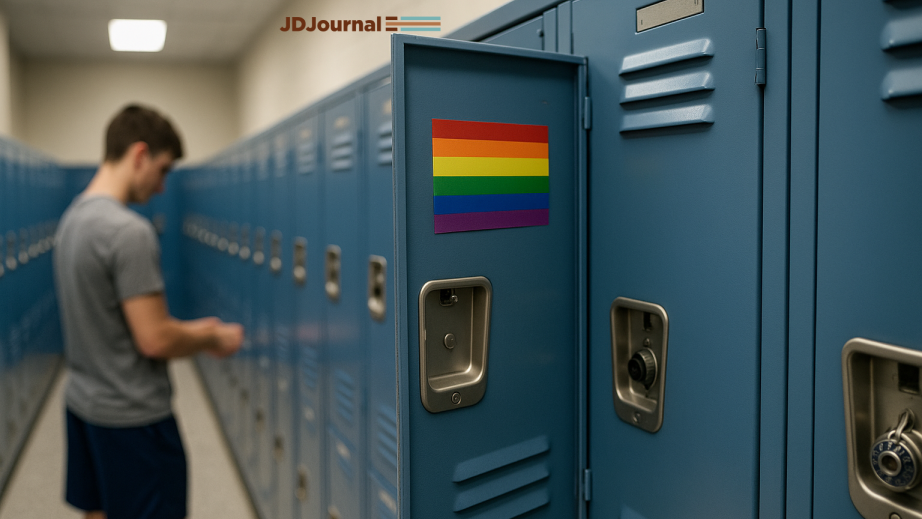
The U.S. Department of Justice has filed a major Locker Room Case against the Loudoun County School Board in Virginia. The DOJ argues that the district violated students’ constitutional and civil-rights protections by allowing a transgender student to use the boys’ locker room and by disciplining students who objected. The case quickly intensified debates over gender identity, privacy, and school policy.
DOJ Details Its Locker Room Case Claims
According to the complaint, the school board allowed a student assigned female at birth, who identifies as male, to use the boys’ locker room. Several male students expressed discomfort and raised objections. The DOJ says the district disciplined those students, and federal attorneys argue that these actions violated their First Amendment rights.
The department also says the policy forced students and staff to “accept and promote gender ideology,” even when it conflicted with their religious or personal beliefs. Because of this, the DOJ claims the school board denied certain students equal protection based on religion and then retaliated when they shared their concerns.
Assistant Attorney General Harmeet Dhillon stressed that students do not “shed their First Amendment rights at the schoolhouse gate.” She added that the district pressured students to accept beliefs they did not share.
Background Leading to the Locker Room Case
This Locker Room Case comes as school districts across the country face scrutiny over policies governing locker-room and restroom access for transgender students. Loudoun County often sits at the center of these debates.

In August, the school board reaffirmed its transgender-inclusive policy. The vote followed a July warning from the U.S. Department of Education, which threatened consequences if the district did not revise the policy. Board members argued that changing the policy would conflict with federal court rulings that protect transgender students.
However, in September, the Education Department’s Office for Civil Rights found that Loudoun County treated complaints unfairly. Investigators reported that the district reviewed complaints from the transgender student thoroughly but did not give the same attention to complaints from male students uncomfortable with the locker-room arrangement. The DOJ incorporated these findings into its lawsuit.
State officials also entered the dispute. In May, Virginia’s governor asked the state attorney general to investigate whether the school district retaliated against students and parents who opposed the policy. After reviewing the matter, the attorney general concluded that Loudoun County penalized several students who expressed discomfort.
These events shaped the foundation for the DOJ’s current Locker Room Case.
Why the Locker Room Case Could Shape National Policy
The Locker Room Case could become a major legal turning point. It raises important questions about how schools should balance transgender students’ rights with the privacy and religious rights of other students.
Some of the central questions include:
- Should schools require students to follow policies that conflict with their religious beliefs?
- Does disciplining students for objecting to locker-room access violate their First Amendment rights?
- How can schools protect the rights of transgender students while also respecting the privacy expectations of others?
This case also stands out for an unusual reason. In earlier high-profile cases, transgender students challenged schools that restricted their access. In this case, federal prosecutors challenge a district for expanding access and disciplining students who objected. This shift signals a significant change in how gender-identity cases develop.
Because of this, the Locker Room Case has the potential to influence future interpretations of Title IX, privacy standards, and free-speech protections in public schools.
A Growing Clash Between Federal and Local Authority
The Locker Room Case also highlights the growing tension between school boards, state officials, and federal agencies. Loudoun County has become a central point in national debates over parental rights, gender policy, and school governance.
Earlier rulings such as G.G. v. Gloucester County School Board expanded protections for transgender students. The DOJ’s new lawsuit questions whether those protections can coexist with constitutional rights held by other students. The case also reveals how school districts often find themselves caught between conflicting expectations from different groups.
As debates intensify, communities nationwide struggle to find balance. Some support broad protections for transgender students. Others argue that certain policies infringe on privacy or religious freedom. The Locker Room Case brings these conflicts into clear focus.
What Comes Next
As litigation continues, several paths are possible.
A court could side with the DOJ. If that happens, Loudoun County may need to revise its policy and stop disciplining students who express objections. Another possibility is that the court supports the school board, ruling that the district acted within its authority when it adopted the policy.
The decision may also affect future federal guidance under Title IX. Lawmakers at the state and national levels could use the decision to push for clearer standards on sex-separated facilities in public schools.
School districts across the country may also adjust their policies to avoid similar disputes. As a result, communities already divided over gender-identity issues may face new debates.
For now, educators, parents, civil-rights groups, and legal observers continue to watch closely. The outcome of the Locker Room Case may shape how American schools address gender identity, privacy, and constitutional protections for years to come.
Advance your legal career with LawCrossing. Explore thousands of verified legal jobs, gain insider career insights, and take your next step with confidence today.
See Related Articles:
•15 Top Law Schools: Best Program for Aspiring Lawyers
•Decode Law Schools Ranking
•Law School Profile


