


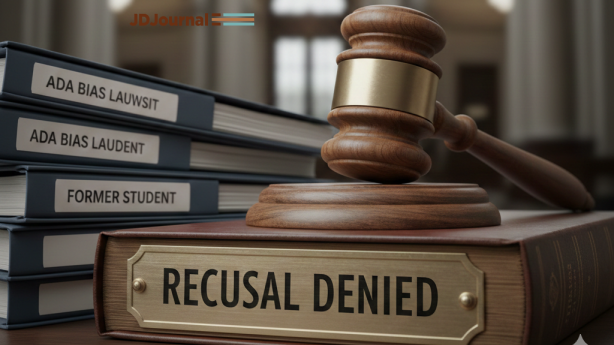
A federal judge refused to step aside in an ADA Bias Lawsuit filed by a former law student who says the University of California College of the Law, San Francisco, denied him required accommodations for Tourette syndrome. As a result, the case remains with U.S. District Judge Edward M. Chen in the Northern District of California.
Background of the ADA Bias Lawsuit
The plaintiff, Tenor Ickes, claims the school ignored his requests for flexible academic accommodations. Moreover, he says these adjustments were medically necessary to manage Tourette syndrome. Without them, he struggled to meet the school’s strict deadlines and heavy workload.
Ickes argues that the school’s refusal forced him out of the program and violated the Americans with Disabilities Act. Under the ADA, universities must offer reasonable accommodations to students with documented disabilities. In addition, he insists the school failed to engage in a true interactive process and relied on rigid policies that harmed students with neurological conditions.
The Recusal Motion
As the case moved forward, Ickes asked Judge Chen to recuse himself. He argued that the judge could not remain impartial. However, he did not provide evidence that met the legal standard for disqualification. He also asked the court to transfer the case to another division, claiming the move would promote fairness and reduce perceived bias.
Recusal motions often appear in high-stakes cases. Even so, courts grant them only when there is a real conflict of interest or clear proof of prejudice. Therefore, simple disagreement with a judge’s decisions is not enough.

Judge Chen’s Decision
On December 7, Judge Chen denied both requests. He explained that Ickes offered no factual basis for recusal under federal law. Furthermore, he noted that assumptions about bias do not justify removing a judge.
Because there was no valid reason to move the case, he also rejected the reassignment request. Consequently, the lawsuit will continue in the San Francisco division under his supervision.
Judge Chen emphasized that recusal is appropriate only when there is a genuine conflict or clear evidence of partiality. Thus, he stated that negative assumptions about the court’s motives do not meet the legal standard.
Legal Standards for Recusal in the ADA Bias Lawsuit
Under 28 U.S.C. § 455, a judge must recuse if their impartiality could reasonably be questioned. Courts interpret this standard strictly. To succeed, a party must show:
- a personal or financial interest in the case,
- prior involvement in the matter,
- a proven pattern of bias, or
- prejudicial statements made outside the court.
Judge Chen determined that none of these factors applied. In his view, an objective observer would not doubt his neutrality.
Disability Accommodation Issues Highlighted in the ADA Bias Lawsuit
This ADA Bias Lawsuit highlights a wider debate about disability support in law schools. Institutions must comply with the ADA and the Rehabilitation Act. Nevertheless, many students with neurological or chronic conditions still face challenges when seeking accommodations such as:
- extended deadlines,
- reduced course loads,
- quiet or private exam settings,
- remote learning options, and
- flexible attendance rules.
Studies show that universities are improving accessibility. However, professional schools often remain more rigid. Because of this, disabled students may feel excluded from demanding programs with strict attendance and exam rules.
Cases like Ickes’ may encourage schools to rethink their policies and improve the interactive process required under federal law.
What Happens Next
With the recusal issue resolved, the lawsuit will now move into its next stages. These steps may include:
- continued discovery,
- motions that test the merits,
- settlement discussions, and
- possibly a trial.
Therefore, the outcome could influence how UC Law San Francisco handles future accommodation requests. It may also, in turn, help shape national expectations for disability compliance in law schools and other professional programs.
Ickes maintains that the school’s actions harmed both his academic progress and his long-term career path. Meanwhile, the university has not offered detailed public comments and is expected to dispute his claims.
Conclusion
The denial of the recusal motion marks an important early moment in the ADA Bias Lawsuit. Although Ickes argued that the judge could not remain impartial, the court found no legal grounds to support his claim. As the case moves forward, it may influence how law schools interpret their ADA obligations and how they support students with complex neurological needs.
Find your next legal opportunity today. Visit LawCrossing to explore thousands of verified attorney and legal job openings. Start your search now and take the next step in your legal career.
See Related Articles:
•15 Top Law Schools: Best Program for Aspiring Lawyers
•Decode Law Schools Ranking
•Law School Profile


